GitHub
Connect organizations and repositories, trigger analysis on pushes and pull requests, and return gate results to delivery workflows.
Evidence exchanged
- Repository metadata
- Push and pull-request events
- Checks and gate results
Final-state integrations and alerts
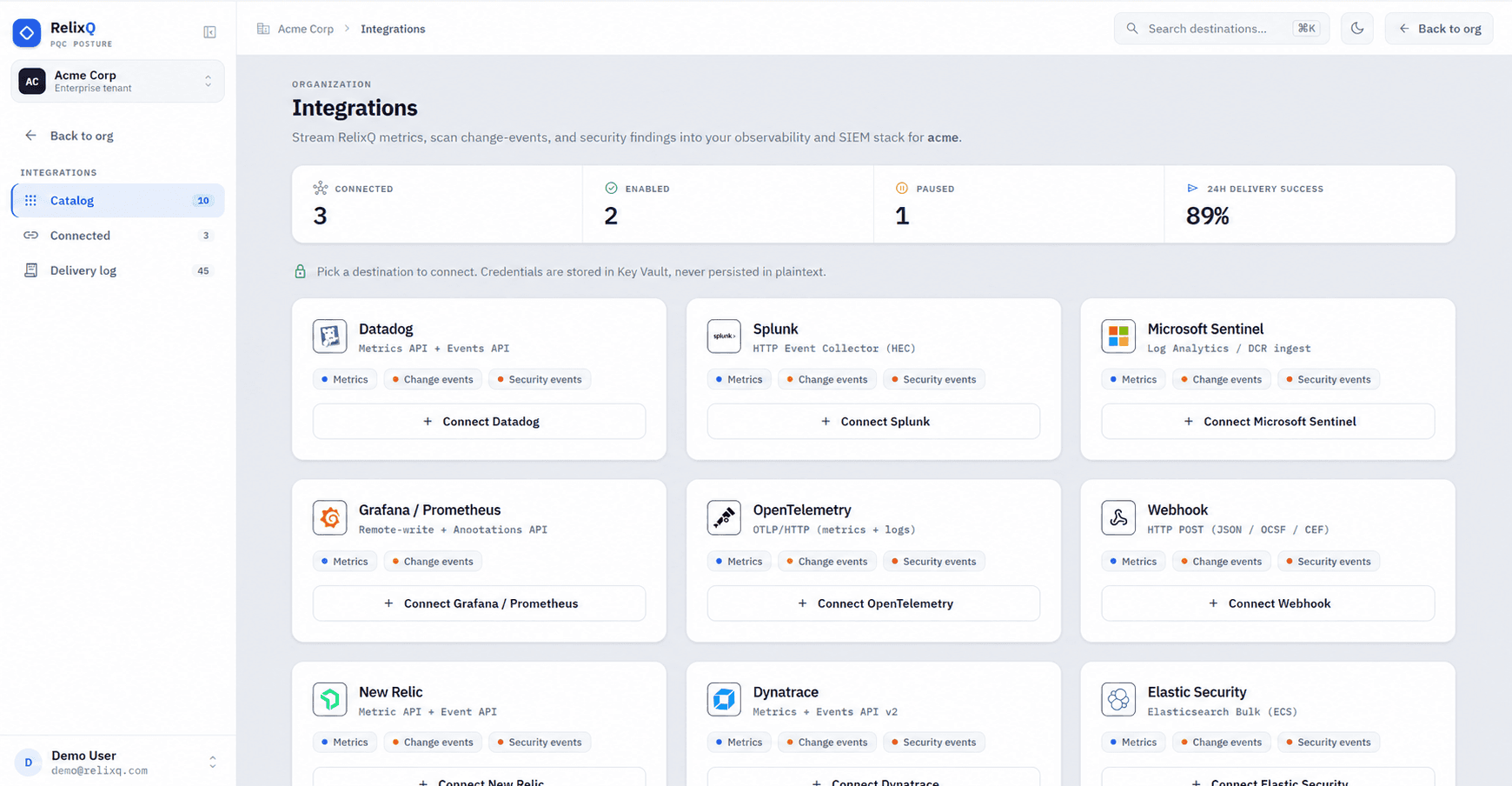
This product-direction catalog shows the intended RelixQ SaaS operating model, including roadmap connections. Bring source, identity, build, artifact, endpoint, cloud, and runtime evidence into RelixQ, then route prioritized posture back to the teams and systems that act on it.
Evidence route
Connected operations
Connect
Repositories · identity · CI · APIs · cloud · runtime
Normalize
Evidence · provenance · confidence · ownership
Route
Policy · priority · deduplication · escalation
Operate
SIEM · tickets · on-call · chat · webhooks
Product-direction view
This page intentionally includes the final-state roadmap. The Developer Guide documents the currently configurable surfaces and calls out where setup remains API-first, preview, or planned.
One operating layer
RelixQ keeps provenance, confidence, scope, ownership, policy, and remediation state connected as data moves between tools. Teams see the same decision record without rebuilding context in every destination.
Connection catalog
Each connection declares its direction, delivery path, and evidence contract so security, engineering, and platform teams can design the complete operating workflow.
Connect the estate
Authorize organization-scoped discovery, select repositories, and keep cryptographic evidence current as code changes.
Operating outcome
Repository context, ownership, branches, pull requests, and change events enter one evidence graph.
Connect organizations and repositories, trigger analysis on pushes and pull requests, and return gate results to delivery workflows.
Evidence exchanged
Discover projects and groups, analyze merge-request changes, and publish policy and remediation context into GitLab workflows.
Evidence exchanged
Connect workspaces and repositories, receive change events, and carry cryptographic policy into pull-request and pipeline decisions.
Evidence exchanged
Map projects and repositories, analyze branch and pull-request activity, and feed posture decisions into Azure delivery workflows.
Evidence exchanged
Govern access
Federate workforce access and automate user and group lifecycle through enterprise identity standards.
Operating outcome
Authentication, role assignment, provisioning, and deprovisioning remain organization-scoped and auditable.
Federate workforce sign-in and synchronize users and groups from Microsoft Entra ID into governed RelixQ organizations.
Evidence exchanged
Connect Okta federation and lifecycle management to organization access, group mapping, and deprovisioning policy.
Evidence exchanged
Use Ping federation and provisioning for enterprise sign-in, organization membership, and governed account lifecycle.
Evidence exchanged
Connect another enterprise identity provider through documented OIDC, SAML 2.0, and SCIM 2.0 contracts.
Evidence exchanged
Bring the evidence
Use the connection pattern that matches each evidence source—from a developer pipeline to an enterprise inventory feed.
Operating outcome
Every input retains provenance, collection time, scope, confidence, and the organization or project it belongs to.
Run baseline-aware scans and policy gates from GitHub Actions, GitLab CI/CD, Azure Pipelines, Bitbucket Pipelines, or Jenkins.
Evidence exchanged
Automate projects, scans, evidence upload, queries, exports, and release decisions with organization-scoped credentials.
Evidence exchanged
Ingest software inventories and preserve direct and transitive package evidence for cryptographic analysis and correlation.
Evidence exchanged
Ingest, enrich, and export cryptographic inventories with normalized components, relationships, provenance, and migration context.
Evidence exchanged
Accept and emit standard static-analysis results so cryptographic findings remain portable across engineering systems.
Evidence exchanged
Observe authorized endpoints and certificate inventories to track negotiation posture, expiry, weak cryptography, and PQC readiness.
Evidence exchanged
Correlate cloud key, certificate, listener, gateway, service, identity, and configuration signals with code and asset evidence.
Evidence exchanged
Operationalize findings
Deliver normalized findings and posture changes into the systems security teams already use to investigate and respond.
Operating outcome
Security operations receives stable event identities, evidence links, severity, confidence, ownership, and lifecycle state.
Stream findings, score changes, policy events, and connector health into Splunk searches, dashboards, and detections.
Evidence exchanged
Publish normalized RelixQ evidence into Sentinel for analytics, hunting, workbooks, and incident automation.
Evidence exchanged
Index cryptographic exposure and governance events for Elastic search, detection, visualization, and case workflows.
Evidence exchanged
Share exposure signals and asset context with Falcon workflows to support unified investigation and prioritization.
Evidence exchanged
Export vendor-neutral security events for downstream lakes, analytics platforms, and enterprise detection pipelines.
Evidence exchanged
Measure posture
Put readiness, exposure, scan health, and change signals beside the reliability data platform teams monitor every day.
Operating outcome
Teams can graph posture trends, correlate releases with exposure, and alert on service-level crypto risk.
Ingest runtime observations and export vendor-neutral posture metrics, logs, traces, and change events through standard OTLP pipelines.
Evidence exchanged
Send readiness metrics and events into dashboards, monitors, service views, and incident workflows.
Evidence exchanged
Correlate crypto posture with monitored services, releases, ownership, and runtime dependencies.
Evidence exchanged
Deliver crypto exposure and readiness signals for dashboards, NRQL analysis, alerts, and service context.
Evidence exchanged
Power organization, portfolio, and service-level readiness dashboards using time-series posture metrics.
Evidence exchanged
Put work in motion
Create owned remediation work with evidence, recommended action, due dates, and synchronized lifecycle state.
Operating outcome
A finding remains connected to its work item from assignment through verified remediation.
Create issues or service requests from routed findings and synchronize assignee, status, comments, and resolution.
Evidence exchanged
Open governed remediation records and keep risk, change, ownership, and closure evidence synchronized.
Evidence exchanged
Turn actionable findings into repository-native work with precise code locations and verification state.
Evidence exchanged
Create and synchronize work items within Azure projects while preserving evidence and policy context.
Evidence exchanged
Route prioritized remediation into engineering team workflows and follow progress through verified closure.
Evidence exchanged
Escalate what matters
Page the right team when exposure crosses policy, evidence regresses, or a critical service changes posture.
Operating outcome
Routing policy controls urgency, deduplication, escalation, acknowledgement, and resolution synchronization.
Trigger deduplicated incidents with urgency, service, runbook, evidence, and ownership context.
Evidence exchanged
Route critical exposure and platform-health events through team schedules and escalation policies.
Evidence exchanged
Deliver policy-based alerts to on-call teams with stable incident keys and direct evidence links.
Evidence exchanged
Connect crypto posture alerts to Grafana escalation chains, schedules, and incident response workflows.
Evidence exchanged
Feed prioritized events into enterprise correlation and response while synchronizing operational state.
Evidence exchanged
Keep teams informed
Send concise, actionable notifications to team channels or compose custom automation around signed events.
Operating outcome
Every message links back to the governed finding, affected asset, owner, policy, and recommended action.
Route rich alerts and posture summaries to channels with actions for assignment, acknowledgement, and investigation.
Evidence exchanged
Deliver actionable cards and portfolio summaries to the teams responsible for services and remediation.
Evidence exchanged
Send project and service alerts into spaces with direct links to evidence and next actions.
Evidence exchanged
Reach engineering and operations channels through structured webhook notifications and lifecycle updates.
Evidence exchanged
Send immediate alerts, scheduled digests, executive summaries, and ownership reminders to governed recipient groups.
Evidence exchanged
Build custom workflows from versioned, signed events with retries, delivery history, and idempotency keys.
Evidence exchanged
Control plane
Test credentials and delivery, inspect the most recent success, trace failures, replay signed events, and monitor freshness across source and destination connections from one managed SaaS surface.
Integration control plane
Configure sources and destinations, test connections, apply routing policies, and inspect delivery health from one SaaS workspace.

Alert intelligence
RelixQ evaluates evidence changes in context, groups related observations, and routes one actionable record with the affected asset, policy, owner, confidence, and recommended next step.
Exposure
Long-lived data becomes harvestable, reachable, or falls inside its migration window.
Posture
A project, business unit, or portfolio crosses a readiness threshold or moves unexpectedly.
Finding
New critical evidence is discovered or a verified finding returns after a code or configuration change.
Protocol
A TLS endpoint changes negotiation behavior, loses hybrid support, or accepts a prohibited classical path.
Certificate
A certificate approaches expiry, uses disallowed cryptography, or breaks an expected trust relationship.
Governance
A policy fails, an exception approaches expiry, ownership is missing, or a remediation SLA is breached.
Delivery
A pipeline is warned or blocked by net-new risk, score, severity, HNDL, or regression policy.
Health
A repository, scanner, endpoint, feed, or destination stops producing expected evidence.
Lifecycle
The same alert identity follows the issue through every connected system, preserving a complete operational and audit trail.
Evaluate new evidence and state changes against organization, project, asset, and release policies.
A typed signal with evidence and policy context.
Group related observations by stable fingerprint, asset, service, owner, and time window.
One incident instead of repeated notification noise.
Apply severity, confidence, business criticality, ownership, schedules, and escalation rules.
The right destination, urgency, and response team.
Synchronize assignment, acknowledgement, comments, and workflow state across RelixQ and connected tools.
A visible owner and governed response trail.
Retest changed evidence, close the alert when policy passes, and reopen it automatically on regression.
Evidence-backed closure with complete history.
Routing policy
Compose routing rules from evidence, risk, ownership, and timing—not from a one-size-fits-all severity label. Policies are organization-scoped, versioned, testable, and visible in the decision history.
Connection governance
RelixQ treats integrations as governed SaaS connections. Administrators control scope, credentials, routing, retention, and delivery while operators retain the evidence needed to understand every action.
Connect only the organizations, projects, repositories, services, and destinations that each workflow requires.
Store and rotate connection credentials independently, with masked values and auditable administrative changes.
Use connection tests, signed payloads, retries, idempotency keys, delivery history, and health alerts.
Preserve rule version, evidence link, destination, delivery outcome, acknowledgement, and resolution history.
Design the operating path
We will map the evidence inputs, routing policy, destination workflows, ownership model, and success criteria for a RelixQ evaluation.