
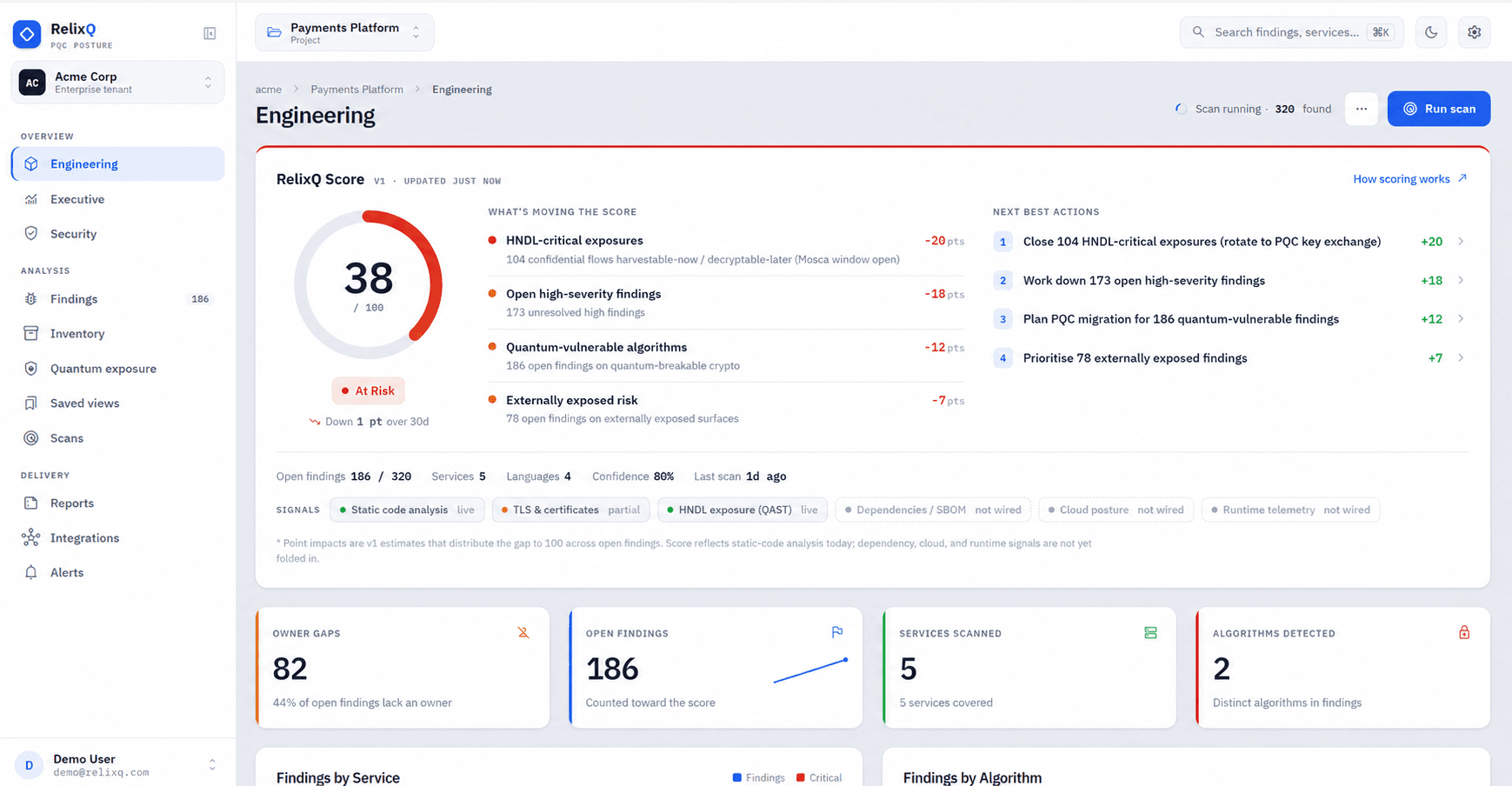
Engineering
Priorities tied to evidence
RelixQ Score, HNDL-critical exposure, next actions, service context, and confidence in one working view.
Enterprise post-quantum exposure management SaaS
RelixQ finds quantum-vulnerable cryptography, shows which long-lived data is exposed, and turns that evidence into remediation, reporting, and release controls.
Engineering
RelixQ Score, HNDL-critical exposure, next actions, service context, and confidence in one working view.
In one sentence
RelixQ is a managed SaaS platform for enterprise post-quantum exposure management: cryptography discovery, harvest-now-decrypt-later exposure, QAST validation, the RelixQ Score, governance, and developer release gates.
The enterprise problem
The work crosses security leadership, application teams, platform engineering, and governance. Each team needs a different operating artifact from the same evidence.
Code, dependencies, certificates, TLS, JWT, SAML, mTLS, cloud services, and build systems all carry migration assumptions.
Security teams need data lifetime, harvestability, reachability, ownership, and confidence—not a flat count of algorithms.
Without retests, policies, tickets, exceptions, and gates, the same exposure returns after every remediation cycle.
Why RelixQ
RelixQ connects each finding to how long the data must stay private, whether it can be harvested, where it is reachable, who owns it, and how confident the evidence is. The same evidence then drives remediation, governance, and release controls.
Inventory alone
With RelixQ
Find cryptography across code, dependencies, certificates, protocols, cloud services, and infrastructure.
Rank work by data lifetime, harvestability, reachability, confidence, and score impact.
Collect consent-gated, read-only evidence from approved targets.
Assign owners, remediate, retest, report, and enforce release gates.
Four connected capabilities
The product mirrors the operating model, while broad language, infrastructure, and interoperability coverage keeps the evidence chain intact across teams and tools.
Inventory & CBOM
Discover cryptography across code, dependencies, certificates, TLS, protocols, cloud services, and infrastructure.
Explore capabilityQAST & HNDL
Rank work by how long data must stay private, whether it can be harvested, where it is reachable, and how confident the evidence is.
Explore capabilityPQC Lab
Inspect read-only negotiation evidence for approved targets, including hybrid support, classical acceptance, and downgrade context.
Explore capabilityRelixQ Score, governance & gates
Track posture, assign owners, manage exceptions, retest fixes, and block net-new exposure with baseline-aware release gates.
Explore capabilityEnvironment fit
31
Semantic, parser-backed, and curated rule coverage across modern, legacy, specialist, and infrastructure-heavy estates.
View coverage7
Source, configuration, dependencies, TLS, cloud keys, cloud TLS infrastructure, and runtime telemetry—joined in a readiness graph.
View coverage13
Infrastructure, proxy, container, key-material, and platform configuration stay inside the same evidence model.
View coverageOpen
SARIF, CycloneDX, SPDX, OCSF, OpenTelemetry, APIs, and webhooks keep the result portable.
View coverageProduct proof
Leadership sees posture, security sees ranked exposure, and engineering sees the action behind every finding.
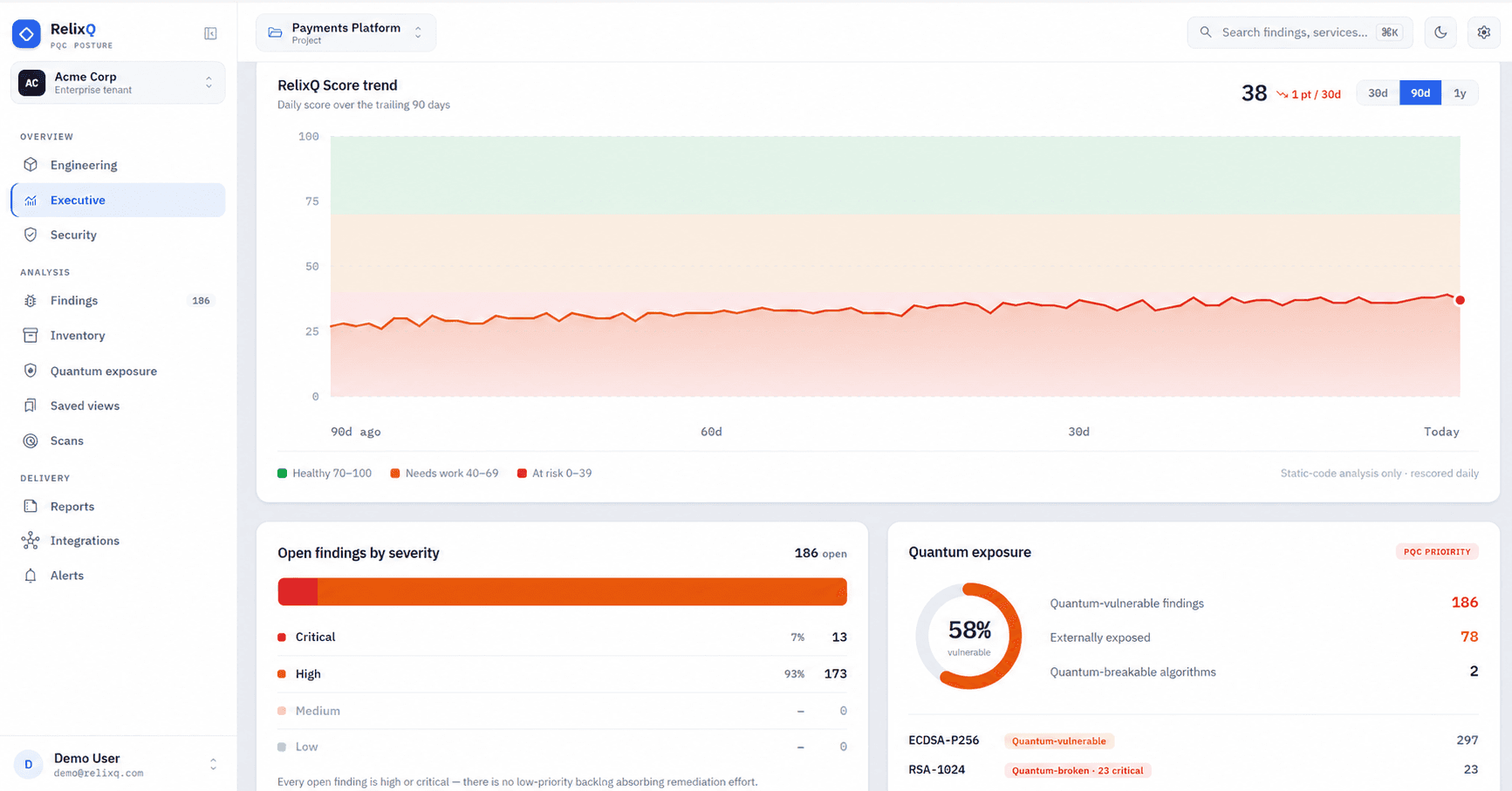
Leadership
Track the RelixQ Score, open findings, and quantum exposure in one leadership view.
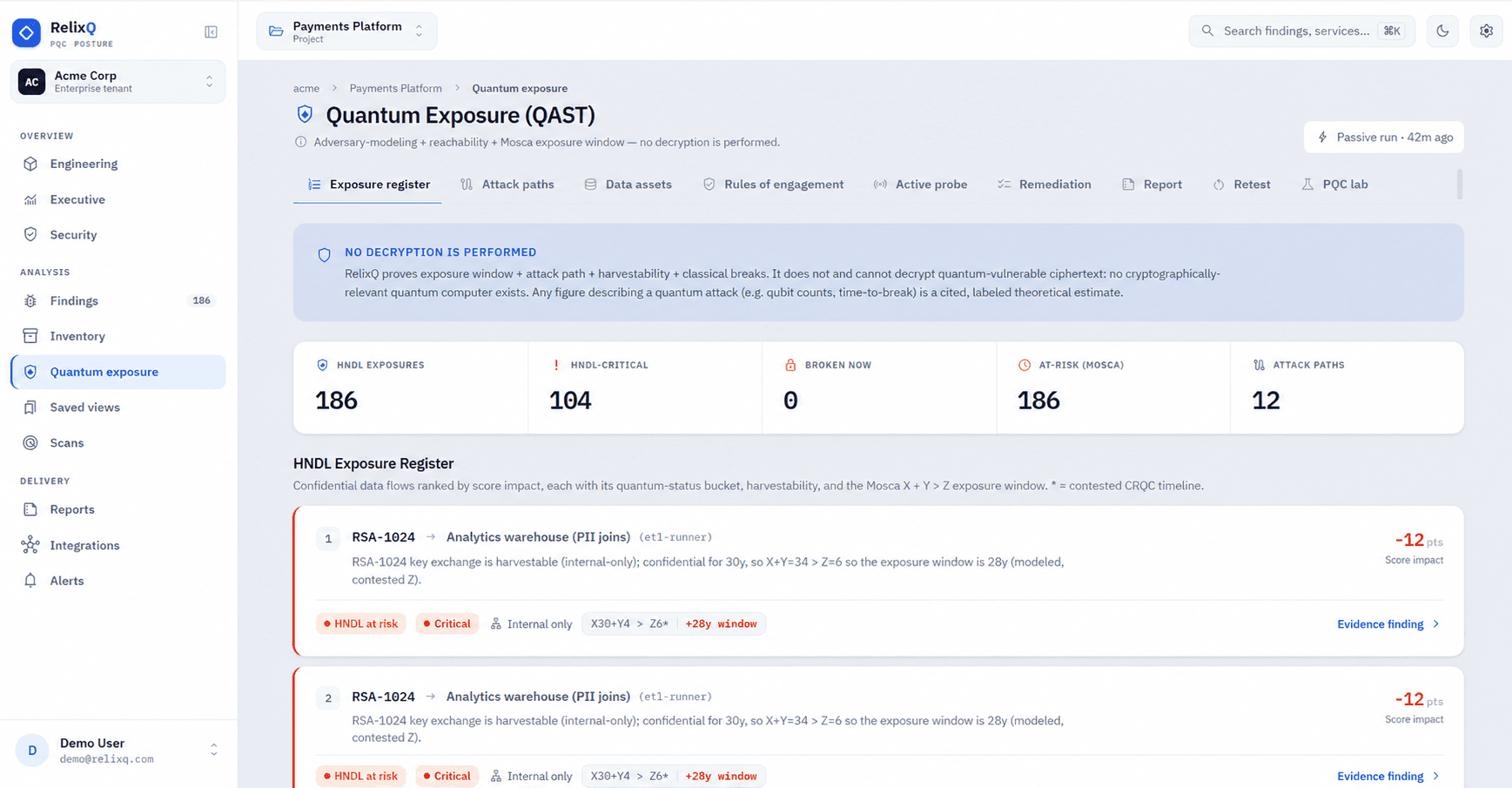
Exposure
Rank HNDL exposure by data lifetime, harvestability, reachability, assumptions, and score impact.
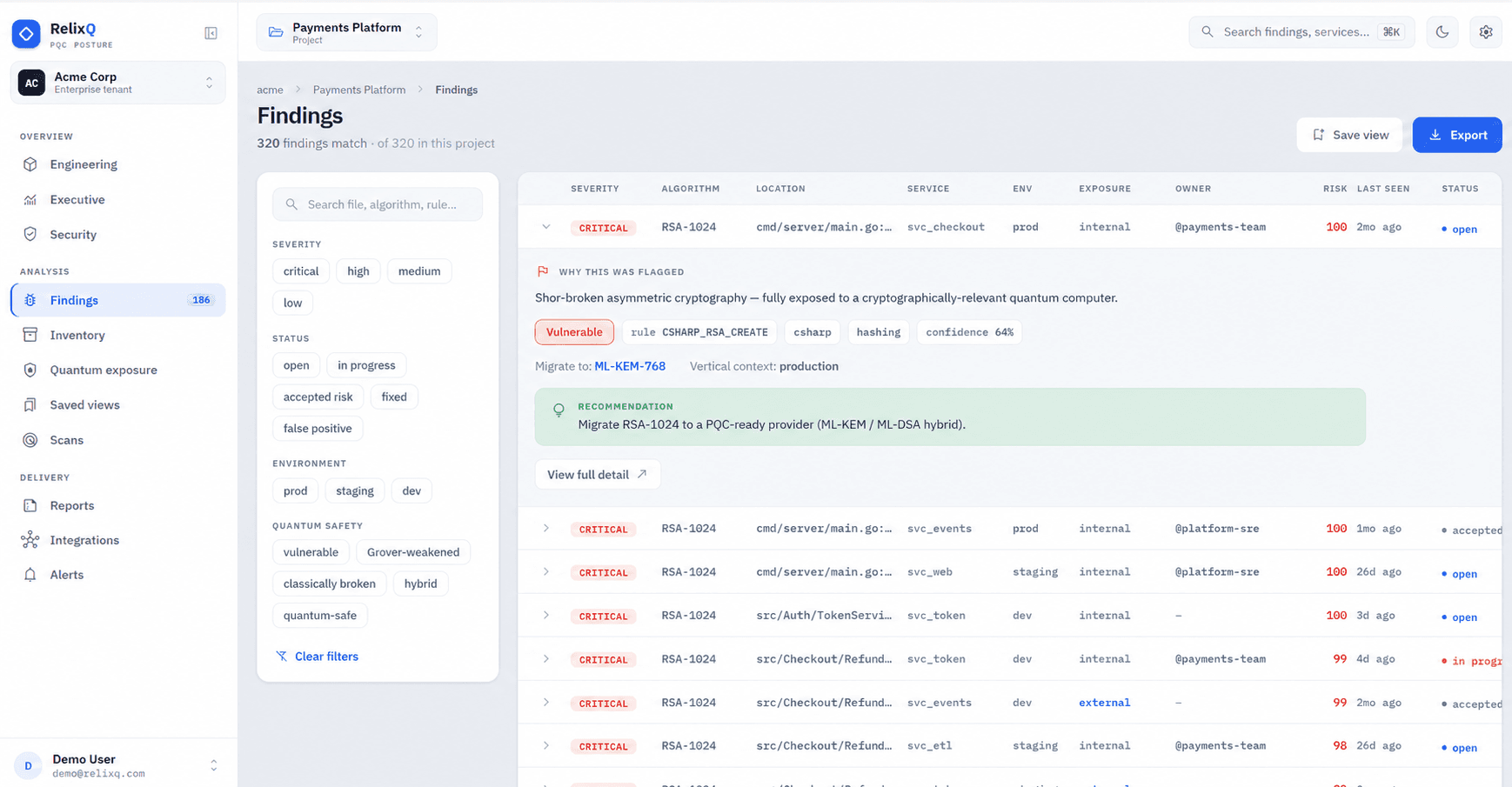
Engineering
Give engineering the finding, owner, confidence, migration target, recommendation, and status in one workbench.
One product, four teams
Leadership, security, engineering, and governance work from the same findings, assumptions, owners, and progress.
Solution
See posture, exposure trends, and the priorities changing the RelixQ Score.
View solutionSolution
Triage findings with evidence, owners, migration targets, and retest history.
View solutionSolution
Automate scans, route evidence, and enforce baseline-aware release gates.
View solutionSolution
Keep reports, policies, exceptions, and accepted risk tied to technical evidence.
View solutionFrequently asked
Short answers with the same facts the Developer Guide and Trust Center carry. Longer versions live in the guide.
Trust
RelixQ separates observed evidence, modeled quantum risk, and proven classical breaks. Active validation stays within approved scope under signed Rules of Engagement.
RelixQ is delivered as a managed service with data handling documented in the Trust Center.
Active validation is limited to approved targets under a signed, project-specific Rules of Engagement workflow.
Draft, verified, planned, and review-required material stays clearly labeled for buyers and procurement teams.
See RelixQ on your portfolio
Scope a controlled SaaS evaluation around the applications, data, and delivery workflows that matter most.